Phase matching in Vector-Beam Driven High Harmonic Generation in 3D-printed Gas Cells
Laser driven x-ray sources are capable of achieving nanometer length scale imaging while simultaneously durations on the order of nanoseconds, enabling microscopy at the fastest timescales and the smallest length scales. Through the use of mid-infrared lasers, the generated light can extend into the soft x-ray regime, where there are exciting applications in biological imaging vvia the water window, magnetic imaging at the absorption edges of common magnetic materials, and scales appropriate for upcoming nodes of semiconductor lithography. Tabletop high harmonic sources (HHG) are a leading light source for this cutting edge microscopy, and is an area of expertise within STROBE. At the cutting edge, we are now capable of generating HHG with advanced polarizations, STROBE research has shown that HHG can generate x-rays with radial or azimuthal polarization.
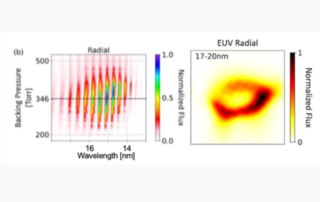
STROBE scientists have now combined both advanced polarization HHG with longer wavelength drivers, making soft x-ray vector polarization beams for the first time. Using specially designed 3D printed gas cells, they were able to make high brightness beams at 1300 nm driving wavelengths and measure the full pressure curve that describes the efficiency of generating light known as the phase matching curve. Even at harmonic orders surpassing the 71st was the ring like structure in the harmonic beam clearly observed, indicating high control over the driving wavelength and polarization. A model based on the laser modes and the imparted phase accurately predicted the change in pressure needed to efficiently generate light, expanding existing thery for use with these new vector polarization states.