masonlw

Home \ Lauren Mason

About Lauren Mason

This author has not yet filled in any details.
So far Lauren Mason has created 322 blog entries.

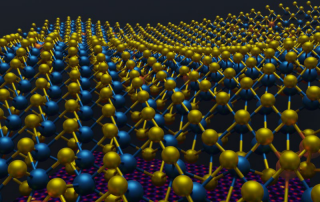
Correlating 3D Atomic Defects and Electronic Properties of 2D Materials with Picometer Precision

Due to the reduced dimensionality, the properties and functionality of 2D materials and van der Waals heterostructures are strongly influenced by atomic defects such as dopants, vacancies, dislocations, grain boundaries, strains, ripples and interfaces. Although x-ray diffraction can determine the 3D crystal structure of 2D materials at atomic resolution, it is blind to crystal defects. Aberration corrected electron microscopy and scanning probe microscopy allow us to see individual atoms without the constraint of crystal averaging. But, seeing atoms is not the same as knowing their 3D coordinates with high precision, which is required for an accurate prediction of properties using quantum mechanics. No ab initio calculations can take a 2D image of atoms as direct input to determine material properties.

A STROBE team led by John Miao (UCLA) in collaboration with scientists from Harvard University, ORNL and Rice University recently developed scanning atomic electron tomography (sAET) to determine the atomic positions and crystal defects in Re-doped MoS2 with a 3D precision down to 4 picometers. They observed dopants, vacancies and ripples, measured the full 3D strain tensor and quantified local strains induced by single dopants. By directly providing experimental 3D atomic coordinates to density functional theory (DFT), they obtained more truthful electronic band structures than those derived from conventional DFT calculations relying on relaxed 3D atomic models, which was confirmed by photoluminescence spectra measurements. Furthermore, they observed that the local strain induced by atomic defects along the z-axis is larger than that along the x- and y-axis and thus more strongly affects the electronic property of the 2D material. It is anticipated that sAET is not only generally applicable to the determination of the 3D atomic coordinates of 2D materials and heterostructures, but also could transform ab initio calculations by using experimental atomic coordinates as direct input to reveal more realistic physical, material, chemical and electronic properties.

Molecular Syringe

Bacteriocins are contractile molecular syringes — nanomachines produced by one bacterium that can puncture the cell membrane of another bacterium to deliver a lethal punch. In this week’s issue of Nature and featured on the cover, STROBE UCLA scientist Hong Zhou and his colleagues present high-resolution structures of the bacteriocin pyocin R2 from P. aeruginosa – in both its preand post-contraction states. The results allow the researchers to suggest in detail how the molecular syringe works, offering insight into how R-type bacteriocins might be developed into a new class of antimicrobials. This work was featured in the April 2020 cover of Nature.

Go to Top