
Congratulations to Clay Klein for Receiving the 2025 Nick Cobb Memorial Scholarship from SPIE
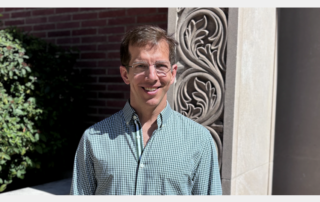
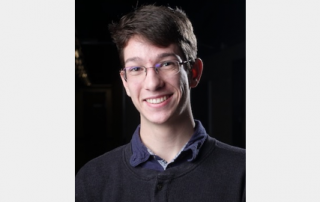
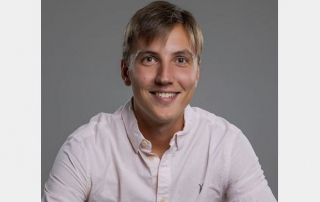
STROBE and JILA graduate student Clay Klein has been awarded the prestigious 2025 Nick Cobb Memorial Scholarship, presented by SPIE, the International Society for Optics and Photonics, and Siemens EDA. The scholarship, valued at $10,000, recognizes Klein’s outstanding contributions to the field of optics and photonics.
“I am honored to be awarded the Nick Cobb Memorial Scholarship,” Klein stated. “This scholarship provides me with the exciting opportunity to share my research in this field and connect with others in the industry at the SPIE conference in February.”
Klein conducts research in the laboratories of JILA Fellows and University of Colorado Boulder Physics professors Margaret Murnane and Henry Kapteyn. His work focuses on cutting-edge advancements in nanoscale extreme ultraviolet imaging science.
The award will be formally presented during the Welcome and Plenary Presentation at the SPIE Advanced Lithography + Patterning Conference in San Jose, California, on February 24, 2025. Congratulations Clay!
Congratulations to Chris Regan for Receiving a 2024 APS Topical Group on Instrument and Measurement Science Fellowship
Prof. Chris Regan received a 2024 APS GIMS Fellowship in recognition “for advancements in the capabilities of in situ transmission electron microscopy, liquid-cell microscopy, and nanometer-scale thermometry, with applications ranging from improvements in computer memories to batteries. This work has an impact on both basic research and industrial applications.”
Fellowship in the American Physical Society is a great honor. In accordance with the APS Constitution, “there shall be elected to Fellowship only such Members who have contributed to the advancement of physics by independent, original research or who have rendered some other special service to the cause of the sciences. Congratulations, Chris!
Congratulations to Christian Tanner for Receiving the 2024 SSRL Scientific Development Award
Tanner works on self-assembling nanocrystals, which could be the basis for less expensive, easier to build displays and solar cells.
What Christian Tanner wants to do, ultimately, is help create materials that could be applied to building better solar cells or video displays — and to do that big-picture work, he coaxes nanoscopically tiny building blocks to put themselves together and watches the process unfold using X-rays at the Stanford Synchrotron Radiation Lightsource (SSRL) at the Department of Energy’s SLAC National Accelerator Laboratory.
For his efforts, Tanner will receive the 2024 SSRL Scientific Development Award, to be presented at the SSRL/LCLS User’s Meeting taking place September 22-27. The award comes with $1,000 to help promote the dissemination of research performed at SSRL.
Congratulations to Laura Waller for being Awarded the Max Planck-Humboldt Medal for Outstanding Achievement in Computational Microscopy
Laura Waller, professor of electrical engineering and computer sciences at University of California Berkeley, has been awarded the Max Planck-Humboldt Medal for her outstanding achievements in computational microscopy.
Prof. Waller uses algorithms – some of which are based on machine learning – to improve microscopy, particularly of biological samples, as well as the imaging of astronomical objects. This pioneer of computational microscopy is combining computer science and simple instruments to achieve such things as making more details visible and creating three-dimensional images or videos. Among other things, Laura Waller has further developed the phase contrast microscope, which can also image transparent objects. She has formulated algorithms that determine quantitative information about the phase of light waves – in simple terms, this is the displacement of light waves relative to each other– from a few images with illumination from different angles. The resulting images not only better visualise the shape of cells, but also allow better cell tracking. In another invention, the DiffuserCam, Waller places an uneven plastic plate on a light sensor, which scatters the incoming light. Very detailed 3D images can then be reconstructed from a single sensor reading, with applications in microscopy and astronomical imaging. The technology also makes it possible to create high-speed videos with low-speed camera equipment.
Congratulations to Benjamin Hammel and Emma Nelson for receiving Poster Awards at the CU Boulder Innovation in Materials Symposium 2024
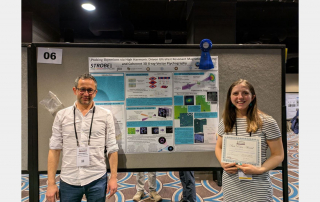
Congratulations to Benjamin Hammel for receiving the First Place Poster Award and Emma Nelson for receiving the Third Place Poster Award at the 2024 Innovation in Materials Symposium! This symposium brought together the materials research community at CU Boulder and beyond for presentations by faculty and students as well as discussion and collaboration opportunities.
Congratulations to Kwabena Bediako for Being Awarded the 2024 Philomathia Prize
The Philomathia Prize has been presented annually since 2022 to an early-career Berkeley faculty member, from any discipline, who demonstrates great distinction and promise in their academic field. The prize, established through a generous endowment gift from the Philomathia Foundation, comes with a monetary award of $200,000 for use at the awardee’s discretion over a three-year period.