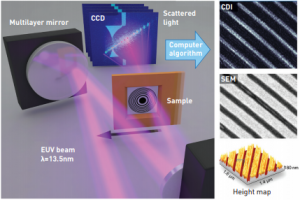
Crystal Clear Imaging: Infrared Brings to Light Nanoscale Molecular Arrangement
Berkeley Lab and University of Colorado-Boulder team develop new way to reveal crystal features in functional materials.
Fort Lewis College will be swimming in the big leagues with its share of a new five-year $94-million grant from the National Science Foundation intended to prepare students for careers in the sciences after graduation.
Ambitious, complex research that leads to breakthrough discoveries requires large-scale, long-term investments. Today, the National Science Foundation (NSF) announces $94 million in funding to support four new Science and Technology Centers (STCs), partnerships that lay the foundations for advances in fields ranging from cell biology and mechanobiology to particle physics and materials science.
UC Berkeley researchers are collaborating with scientists from UCLA, University of Colorado at Boulder and other institutions to arrive at more detailed scientific findings through the improvement of real-time functional imaging.
CU Boulder will expand its role as a national leader in imaging, materials, nano, bio and energy sciences as part of a collaborative partnership awarded $24 million by the National Science Foundation (NSF) to launch a new center.
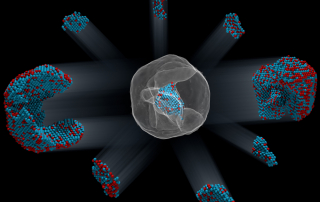
The Science and Technology Center on Real-Time Functional Imaging, known as STROBE, will be headquartered at CU Boulder and will integrate several areas of imaging science and technology, including photon and electron-based imaging, advanced algorithms, big data analysis and adaptive imaging. Named for its relation to stroboscopic imaging, the center is designed to tackle major scientific challenges that have the potential to transform imaging science and technology.
CU Boulder and Fort Lewis College were two of six colleges to receive part of a $24 million NSF imaging science grant. The schools will launch the Science and Technology Center on Real-Time Functional Imaging center (STROBE), which will be headquartered at CU Boulder. The center is designed to tackle major scientific challenges that have the potential to transform imaging science and technology through integrated advanced imaging methods using electrons, X-rays, and super-resolution microscopy.
The University of Colorado at Boulder and Fort Lewis College in Durango are two colleges that will share in a National Science Foundation (NSF) imaging science $24 million grant.
The schools, along with four others in the U.S., are launching the Science and Technology Center on Real-Time Functional Imaging, or STROBE, which will have its headquarters at CU-Boulder.
UC Berkeley will help lead the new Science and Technology Center on Real-Time Functional Imaging, which aims to tackle major scientific challenges by improving imaging technology.
The center, which includes scientists from UC Berkeley, UCLA and the University of Colorado Boulder, will receive $24 million from the National Science Foundation (NSF) over a five-year period, with the possibility of a continuation for five additional years. Naomi S. Ginsberg, associate professor of chemistry and physics and member of the Kavli Energy NanoScience Institute at Berkeley, will lead the efforts for UC Berkeley.
UCLA is helping to lead the new, cutting-edge Science and Technology Center on Real-Time Functional Imaging. The center is funded by a five-year, $24 million award from the National Science Foundation, and includes renowned scientists from the University of Colorado, Boulder, and UC Berkeley. It will tackle major scientific challenges in the physical sciences, life sciences and engineering.
The Science and Technology Center on Real-Time Functional Imaging, known as STROBE, will be headquartered at CU Boulder and will integrate several areas of imaging science and technology, including photon and electron-based imaging, advanced algorithms, big data analysis and adaptive imaging. Named for its relation to stroboscopic imaging, the center is designed to tackle major scientific challenges that have the potential to transform imaging science and technology.
CU Boulder, along with UCLA, the University of California Berkeley, Florida International University, the University of California Irvine and Fort Lewis College in Durango, Colorado, has received the five-year NSF grant.
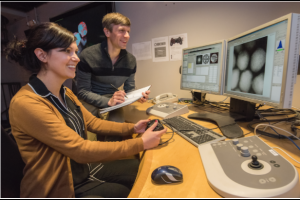
Image Credit: Glenn Asakawa, University of Colorado Boulder