News

Home \ News

Semiconductor nanosensor measures membrane potential

Researchers in the US have developed nanosensors that can be directly inserted into a cell’s lipid membrane and be used to measure membrane potential. The devices, which are based on inorganic semiconductor nanoparticles, could potentially record action potentials from multiple neurons as well as electrical signals on the nanoscale – for example, across just one synapse.

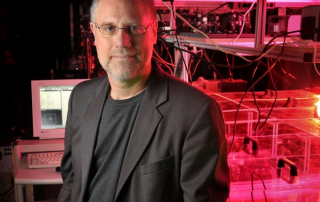
Image Courtesy: Y Kuo and S Sasaki / University of California, Los Angeles

Semiconductor nanosensor measures membrane potential

Professor Shimon Weiss leads team to develop nanosensors that can be directly inserted into a cell’s lipid membrane and be used to measure membrane potential.

The devices, which are based on inorganic semiconductor nanoparticles, could potentially record action potentials from multiple neurons as well as electrical signals on the nanoscale – for example, across just one synapse. Their paper, “Membrane insertion of—and membrane potential sensing by—semiconductor voltage nanosensors: Feasibility demonstration” was published in the January, 12, 2018 issue of Science Advances.

Tracking Energy Flow in Light-harvesting Systems on Native Nanometer and Picosecond Scales

So Ginsberg and her colleagues devised a measurement that transforms an optical “super-resolution” microscopy known as STED (stimulated emission depletion) into a tracker of excitons on these short scales in an organic semiconductor. The technique makes it possible, for the first time, to relate the characteristics of exciton migration efficiency to nanoscale structures within light harvesting materials. “We ended up using the spatial profile of light pulses and the way that they interact with the material in order to excite very small and localized regions that have very sharp boundaries,” she said.

APS TV Features STROBE at JILA

STROBE is featured in an APS TV video about what makes JILA a unique and great place to work. JILA is a unique research and training partnership between the University of Colorado and the National Institute of Standards & Technology. At JILA, scientists develop new research and measurement technologies that broadly advance science and the NIST measurement mission. To date, JILA scientists have been awarded three Physics Nobel Prizes. JILA also trains young innovators who become leaders in industry, academia, and government labs. And after traveling to the many laboratories housed at JILA, APS TV discovers that collaboration amongst its researchers is one of its greatest strengths.

Congrats to Robert Karl Jr. on Receiving the Karel Urbanek Student Paper Award at SPIE Advanced Lithography 2018

We are happy to share the 2018 winner of the Karel Urbanek Student Paper Award at #SPIELitho, Robert Karl Jr., from JILA! His paper was entitled, “Characterization and Imaging of Nanostructured Materials using Tabletop Extreme Ultraviolet Light Sources”. KLA-Tencor is honored to be the sponsor of this annual award at this year’s Metrology, Inspection, and Process Control for Microlithography conference at SPIE Advanced Lithography 2018 in San Jose, California.

Congrats to Jose Rodriguez on Being Selected as a Beckman Young Investigator by the Arnold and Mabel Beckman Foundation

Professor Jose Rodriguez has been selected as a Beckman Young Investigator by the Arnold and Mabel Beckman Foundation… According to the Beckman Foundation website, “these individuals exemplify the Foundation’s mission of supporting the most promising young faculty members in the early stages of their academic careers in the chemical and life sciences, particularly to foster the invention of methods, instruments and materials that will open new avenues of research in science. They were selected from a pool of over 300 applicants after a three-part review led by a panel of scientific experts.”

Congrats to Stan Osher on being elected as a member of the National Academy of Engineering

Election to the National Academy of Engineering is among the highest professional distinctions accorded to an engineer.  Academy membership honors those who have made outstanding contributions to “engineering research, practice, or education, including, where appropriate, significant contributions to the engineering literature” and to “the pioneering of new and developing fields of technology, making major advancements in traditional fields of engineering, or developing/implementing innovative approaches to engineering education.”

Congrats to Jianwei “John” Miao on Receiving the NSF Special Creativity Award

A rarely given Special Creativity Award from the National Science Foundation has been recently bestowed to a pair of UCLA faculty members, along with a leading computer simulation expert at the University of Colorado Boulder, to continue their research on metal alloys for fuel cells.

The principal investigators on the grant are Jianwei “John” Miao, UCLA professor of physics and astronomy and also the deputy director, NSF STROBE Science and Technology Center; Yu Huang, UCLA professor of materials science and engineering; and Hendrik Heinz, an associate professor of chemical and biological engineering at the University of Colorado Boulder.  Huang and Miao are also members of the California NanoSystems Institute at UCLA.

Photo Credit: Reed Hutchinson/UCLA

Go to Top